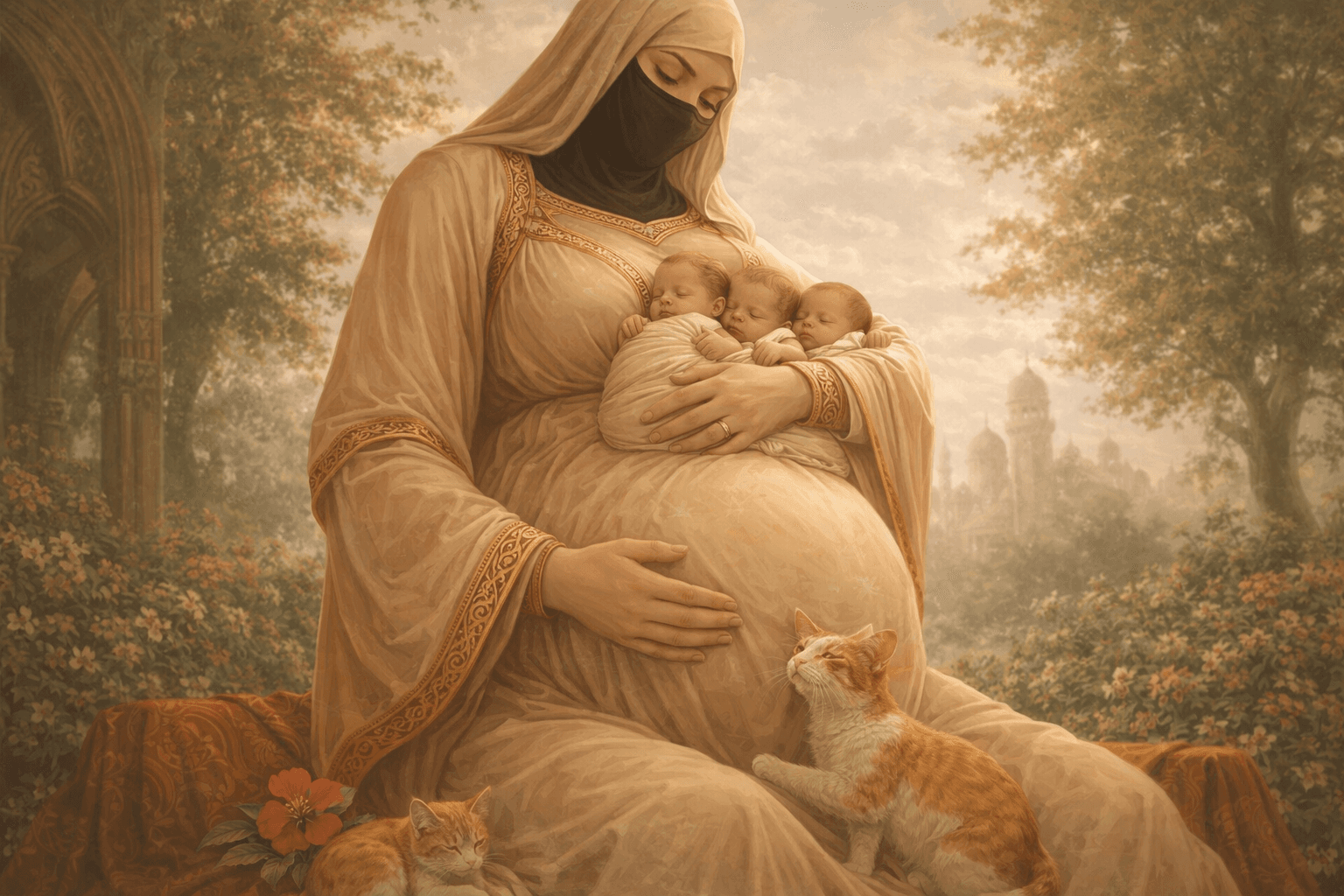
Story
Mother Of 100
This story explores themes of motherhood, legacy, faith, power, and the societal implications of a woman who takes control of her reproductive destiny. Halima Al-Jabbar is a towering figure, both literally and figuratively, who dedicates her life to bearing children for the betterment of the ummah (the Muslim community). She chooses the fathers of her children based not on love or personal connection, but on their perceived spiritual strength and potential to contribute to a stronger future generation.
Cover
ActivePublicarccanonicalpreviewstory
Preview chapterExternal reading
Read the preview here, then continue on the external platform if you want the full long-form story.
Content
Scene: The Choosing of Muadh
The great marble halls of Halima Al-Jabbar's palace echoed with reverent silence. Gold-framed calligraphy shimmered on the high ceilings, verses of Qur'an hand-painted in rich blues and emerald greens. Incense smoke curled through the columns like drifting prayers, and the polished floors gleamed beneath the soft patter of servants' footsteps.
Dozens of men stood in the vast receiving chamber, eyes lowered in humble anticipation. Each had been summoned—handpicked from among the pious, the strong, the brilliant, and the beautiful. They had fasted, bathed, and clothed themselves in pure white. Not one dared look directly at the throne.
And upon that throne, reclined like a celestial judgment, sat Halima Al-Jabbar.
She was immense—8'5" of serene power and sacred motherhood, her figure shrouded in silk the color of twilight. Her veil flowed down over her hair and lower face, leaving only her sharp, hypnotic eyes visible. They scanned the men with regal calculation. Her body, though draped in modesty, betrayed impossible curves—matronly, fertile, and statuesque. Her sheer presence crushed the room in reverence.
At her sides stood two silent female servants, and behind her, her children were watched over by a devoted wet nurse—Idris seated upright like a little prince, Layla cradled in a satin swing, and Mahdi nestled in a woven gold cradle.
Halima raised a single hand.
The room dropped to its knees.
"Bring them forward," she said, her voice wrapped in layers of velvet and command.
One by one, the men approached the throne and knelt before her, offering a short recitation of their lineage, piety, and intentions. Her eyes—calculating, ancient in wisdom despite her young age—read each soul like a divine ledger. Some she dismissed with a mere blink. Others she questioned briefly, her voice gentle but absolute.
And then came Muadh.
He stepped forward, taller than the rest, yet still dwarfed by her gaze. His voice was steady, sincere. He recited verses of mercy and spoke of his upbringing in devotion, his love for the ummah, and his desire to serve its future.
Halima watched him in silence for several long breaths. She didn't speak—she studied him. She saw in him what she needed: strength, humility, and the softness of a man who would not question her will. But more than that, she felt the tinge—a subtle spark she recognized as divine selection. Her womb knew before her mind did.
She stood.
The room collectively inhaled.
Walking down the steps of her throne, each movement of hers was like a prophetess descending from a higher realm. When she reached Muadh, she looked down at him with the reverence of a queen and the hunger of a woman fulfilling a divine duty.
"You will father my next child," she announced.
Muadh trembled, overcome with both awe and the unbearable honor.
"You will remain in the palace until the night of union. You will be purified. You will not touch me unless I summon you. Is that understood?"
He nodded. "Yes, Sayyidati Halima."
Her fingers—warm, enormous, and impossibly soft—lifted his chin.
"You will give me a righteous seed," she whispered. "And then you will return to your life, as one of many who served the womb of the ummah."
She turned, veil trailing behind her like the wings of Jibril himself. Her children giggled in the distance. Her servants began chanting quiet dhikr as she returned to her throne.
The choice had been made.
And the next child of Halima Al-Jabbar was already written into the stars.
Scene: The Union of Flesh and Faith
The palace had gone silent for the night.
All torches were dimmed, and the courtyards were cleared. Only the call of a distant owl and the steady rhythm of water from the marble fountains echoed through the sacred halls. In the innermost chamber—her birthing chamber, consecrated and forbidden to all but the chosen—Halima Al-Jabbar waited.
The room was vast, round, and carved from pale ivory stone. Delicate veils of white silk hung from the high ceiling, flowing like a womb around her. Incense of musk and sandalwood swirled through the air, thick and intoxicating. The floor was padded with rare Persian carpets and cushions woven with verses of the Qur'an, and in the center, on a massive elevated bed carved from cedarwood, she reclined like a goddess cloaked in divine command.
Tonight, she wore no veil.
Her face—revealed for the first time to Muadh—was nothing short of celestial: lips full and sculpted like calligraphy, a jaw both soft and regal, skin a warm bronze kissed by divine light. Her eyes remained sharp and judgmental, but there was warmth behind them now—a kind of sacred hunger.
She was bare, entirely. She did not dress for men. She unveiled only for creation.
The doors opened.
Muadh entered, humbled and trembling in white robes, freshly bathed and perfumed. He had fasted for the day, prayed two rak'at before stepping into the room, and spent hours in contemplation of what was to come. And yet, nothing had prepared him for the vision before him.
He fell to his knees.
Halima did not move. She simply tilted her head, commanding with stillness.
"Rise, Muadh. You are here because I have chosen you. But do not mistake this for permission. Tonight, I create. You obey."
He rose slowly, his breath unsteady. Her body—majestic in scale and shape—was fertility incarnate. Wide hips, full breasts heavy with the milk of previous births, soft thighs that could smother kings, and a stomach that bore the faint signs of her children, stretched but proud. She was not simply beautiful. She was overwhelming.
She held out a hand—massive, warm, expectant.
He placed his in hers. She pulled him toward her like a tide pulling a ship into surrender.
"There will be no pleasure greater than this," she murmured. "Not for you. For me. You are here to be useful. A tool in the garden of Allah."
She guided him onto the bed. Her fingers roamed his body—not with affection, but with judgment, with precision. She studied him, evaluated every line, every breath.
And when she was satisfied, she mounted him.
His breath caught.
She was heavy, soft, divine. Her warmth engulfed him like a return to the womb. Her rhythm was slow and deliberate, her body moving with the weight of centuries, as though each thrust reshaped history. Her hands pressed into his chest, pinning him, owning him. His moans were stifled by awe, his body overwhelmed by sensation—but Halima's face remained composed, serious.
"I feel him," she whispered, eyes distant, as if seeing the unborn child already. "I feel the next of my children."
She leaned down, her breath against his ear.
"You should thank Allah every night for the rest of your life for this moment."
And then she took him harder.
It was not lust—it was purpose. She rode with the dignity of a queen, the savagery of a lioness, and the holiness of a mother creating life for the ummah. When she cried out—low, guttural, divine—it was not ecstasy. It was victory.
When it ended, Muadh collapsed in her arms like a man returned from war.
But Halima only held him for a moment. Then she stood, her body still glistening with divine sweat, her hand cradling her womb.
"It is done," she whispered.
Her servants re-entered the chamber, veils drawn, and led Muadh out in silence.
Halima remained, alone in the flickering candlelight, eyes closed in prayer, her hand on her stomach, whispering to the soul forming within her.
"Allahu Akbar. Multiply us."