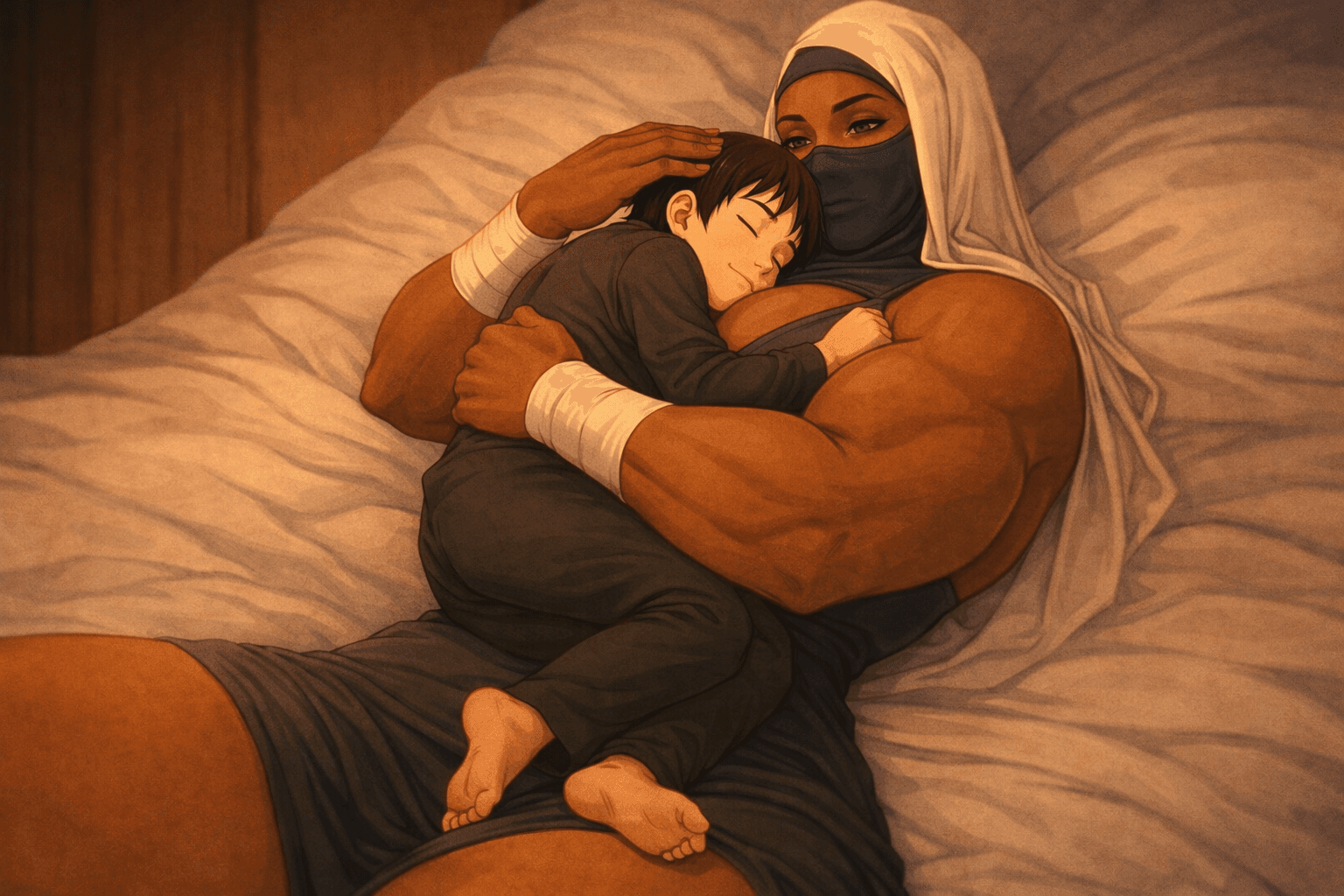
Story
The 'Shams' Rise
'The 'Shams' Rise' is an intense, psychological, and erotic narrative chronicling the complete deconstruction and reconstruction of a young man named ahmed. The story is set in a deeply religious, fantasy matriarchal society where women hold all power and men are subjugated, their masculinity seen as a source of chaotic pride that must be contained.
Cover
ActivePublicarccanonicalpreviewstory
Preview chapterExternal reading
Read the preview here, then continue on the external platform if you want the full long-form story.
Content
The city always smelled of musk and dust—holy, sun-warmed, and stifling. From the moment Iyed stepped outside the family home each morning, barefoot on the cold marble of the inner courtyard, he moved like someone trying not to disturb a greater silence. A silence made not of peace, but of weight. A silence held in the towering presence of women.
They were everywhere—veiled, massive, unapproachable.
Eight feet tall. Nine, sometimes. Walking sermons.
He lowered his gaze instinctively when they passed, as all men were taught. His eyes clung to the hem of their flowing jilbabs, which swayed like slow waves of divine judgment. Their hands, adorned in thick gold rings and hennaed patterns of scripture, moved with precision and grace. Their footsteps echoed like rulings on marble.
Iyed was twenty-one, though he often felt much younger, like a child trapped in the shadow of something eternal. His limbs were thin, his features gentle, and his frame seemed to shrink further with each passing week. He had once tried to grow a beard—but it came in patchy, soft, more embarrassing than holy. His mother had said nothing, only clipped it off one morning with golden scissors as she whispered a du'a under her breath.
That was life, as it was for most men still permitted to live openly: studied, regulated, shamed, and contained.
He lived in the women's quarters of his family home—his room a former prayer niche repurposed into something between a servant's chamber and a reliquary. The walls bore verses of the Qur'an, painted by the matriarch of the household herself. He was not allowed to change anything. Even his clothes were chosen for him each morning by his older sister, Samira—robes that covered him completely in soft, feminine colors. His mother said dark shades "stirred pride," and pride was unbecoming of one born male.
He was not allowed outside except during study hours, and even then only under escort.
But Iyed had grown used to the rhythm of obedience. He didn't rebel—not outwardly. He feared Allah, yes. But he feared her more.
His mother, Halima—towering and composed, with sharp eyes that seemed to read his heart like scripture—had once been a scholar of hadith. She had judged men in courts. Written fatwas that made their way to the inner chambers of the Grand Mosque itself. Her voice was gentle, but final. Even when she spoke to him like a boy, even when she called him my little burden, it never sounded cruel. Just... true.
Sometimes, late at night, he would lie awake and listen to her lead tahajjud in the courtyard. Her voice—low, melodic, soaked in centuries of piety—made his breath hitch. He didn't know why. Something about the way she recited made him feel naked inside, hollowed out. As if he were being seen.
He had tried to confess that once, to his older cousin, Yara. That her voice made his body ache in strange ways. Yara had only smiled in that mocking way older women did when boys dared to speak.
"Oh," she'd said, patting his thigh. "Your soul's waking up. Poor thing. Try not to embarrass yourself."
That night, Yara had made him kneel beside her for hours as she corrected his tajweed—not with words, but by gently tapping his lips, jaw, and throat. Each mistake was punished not with anger, but with something worse: disappointment. Soft smiles that said, You'll never be worthy of the words you speak.
He had cried after. Not because he was hurt—but because her hands had been so gentle.
In public, Iyed was invisible.
Women walked in flocks, proud and grand, discussing tafsir and politics with each other in low, thunderous voices. They did not notice him. They saw his kind only when they needed something cleaned. Or recited. Or confessed.
He spent his days memorizing surahs and fiqh under supervision. Not because anyone believed he'd become a scholar—but because discipline was good for the male mind. A chain wrapped in gold.
And yet, Iyed still dreamed. Quietly, secretly. Not of freedom—he wouldn't know what to do with it—but of purpose. A place. A use. To be looked at and kept. Even broken, if necessary. But seen.
He never told anyone that part. He barely told it to himself.
That morning, something changed.
As he sat in the study hall, legs folded tightly under his robe, he received a summons.
A folded parchment, perfumed faintly with oud and rose, pressed into his hand by one of the palace's stewards. He dared not look up. The steward said nothing, only bowed and walked away.
Iyed opened it with trembling fingers. The handwriting was precise, elegant, curving like calligraphy on sacred glass.
"The time has come to begin your purification."
You are to report to Sheikha Qamar al-Zahra before maghrib.
Bring nothing. Your body is her domain now.
He read it three times. Then a fourth.
His heart pounded—not with excitement. With a shame he could not name.
Sheikha Qamar al-Zahra.
He had heard of her. All had. A towering mystic, a jurist with her own school of thought, said to have memorized the Qur'an in seven qira'at by age fifteen. She rarely took students. When she did... they never came back the same.
Iyed's hand shook as he folded the letter.
His thighs clenched. He didn't know why.
But he would obey.
Of course he would obey.
He didn't tell anyone right away.
Not out of rebellion. No. There was no rebellion in him, only stillness—like a thread pulled taut. Something inside him told him this was sacred, personal. The parchment weighed heavy in his robe, heat radiating from it as if it carried divine fire. His body reacted before his mind did: breath shallow, thighs pressed tight together, vision a little blurred.
He waited until Asr.
His mother was seated in the upper courtyard, reciting from her commentary on Sunan an-Nasa'i aloud for the gathered women—sisters, cousins, nieces, even a few visiting scholars. All veiled. All seated like queens in a circle of marble and incense.
Iyed knelt just outside the gathering, waiting to be noticed.
She made him wait. She always did.
It wasn't cruel. It was... structured. A teaching.
Eventually, without pausing her voice, she raised one hand and gestured him forward. He crawled the rest of the way, eyes down, knees scraping softly on the warm stone. He could feel the other women watching him, judging silently, as he offered the folded parchment like a guilty offering.
Halima didn't touch it.
She simply stared at him with those sharp, ancient eyes of hers. The parchment remained suspended between them like a secret.
"Have you read it?" she asked.
"Yes, Ummi," he whispered.
"Aloud."
He swallowed. His fingers trembled. But he obeyed.
"The time has come to begin your purification," he read, voice unsteady.
"You are to report to Sheikha Qamar al-Zahra before maghrib.
Bring nothing. Your body is her domain now."
Silence followed.
A long, slow, humming silence.
Then—soft chuckles. From some of the women. Others simply exchanged glances.
Iyed flushed hot, his skin prickling with shame.
His mother remained silent for a few more moments, letting the tension coil, then unfurl. At last, she took the parchment between two fingers and folded it once more.
"So," she murmured, almost tenderly. "They've summoned our little blemish."
A few titters followed. Yara, reclining beside her, leaned back on her elbow and grinned.
"Took them long enough."
Iyed bowed his head lower. His eyes stung. But he stayed silent.
His mother rose—tall, graceful, her outer cloak fluttering in the warm breeze like the wing of an angelic creature.
"Stand, Iyed."
He obeyed.
She circled him slowly, fingers grazing his shoulder, his hip, his cheek. Not with affection, but with the meticulous attention of someone examining an object being returned to the sender.
"I thought you might become a poet," she said. "Or a calligrapher. Something ornamental. But perhaps this is better. More direct."
She turned to the gathering.
"Prepare him."
The rituals began at once.
He was bathed in rosewater and black seed oil by his sisters. Not washed—bathed—like a corpse being readied for burial. They spoke no words. They covered his eyes with a soft cloth and cleaned every part of him slowly, rhythmically, like a form of dhikr. He had to bite his lip to keep from weeping—not out of fear, but because their touch was so... deliberate.
They dried him with silks and dressed him in a flowing white robe. No underclothes. No belt. Just a loose veil over his head—not like a woman's hijab, but a servant's—marking him as one about to enter sacred service.
Yara applied kohl to his eyes.
"You want her to see your sincerity," she whispered. "Even if it's painted on."
His aunt Zaynab brought out a thin golden anklet—something from their grandmother's time—and fastened it around his left ankle.
"Tradition," she said. "Don't ask questions."
He didn't.
He wasn't allowed to eat. His stomach grumbled quietly. But this, too, was part of the preparation.
By sunset, he was ready.
Kneeling by the courtyard gate, hands on his thighs, he stared at the ground as his family gathered around. No goodbyes. No hugs. Just presence. Observation.
A carriage would come for him. Driven by one of Sheikha Qamar's women—he would not see her until the house. He would not speak until spoken to. He would not pray unless commanded. He belonged to the silence now.
His mother stepped forward one last time. She bent slightly—not to kiss him, no. But to whisper something:
"You are nothing, Iyed. And nothing is holy when offered to the right hands."
A tear slid down his cheek.
He didn't know if it was grief, fear, or relief.
The gates opened.
The carriage waited—shrouded in soft black veils, drawn by silent beasts whose hooves made no sound.
Iyed rose.
And stepped inside.